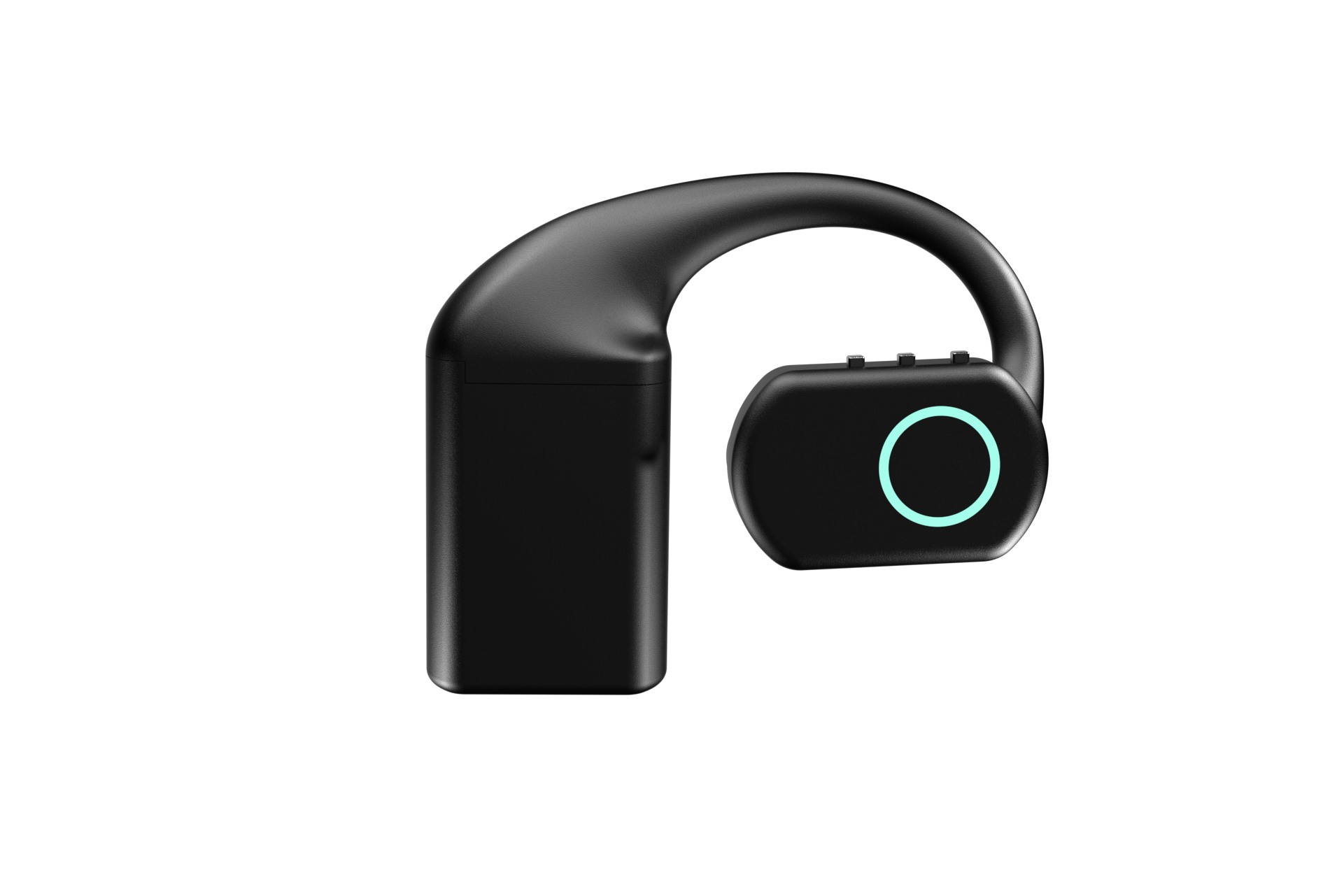
AI headphones
AI headphones in 2026, and what the category means if you are building
AI headphones split into consumer earbuds tied to a vendor assistant and wearable dev kits that stream to your own backend. Here is why that split matters.
July 13, 2026 10 min read
Search the phrase AI headphones and you get a wall of earbuds that translate, summarise and answer questions, with all of the interesting work happening somewhere you cannot see. For an engineer with a voice AI stack already running, that is the wrong product entirely: the assistant is chosen, the endpoint is fixed, and your own speech to text never gets a turn. The useful question is not which pair sounds best on a train. The useful question is whether the thing on your head is a peripheral to somebody else's service or a network endpoint you point at your own backend.
AI headphones is a marketing category covering two unrelated products: consumer earbuds that pair to a phone and drive a closed vendor assistant, and wearable development kits that capture speech and stream it to a backend the owner configures. The second kind is hardware rather than a service, and every model, wake word and voice sits in the stack behind it.
The short version
- The AI in AI headphones does not run in the headphones, it runs in a phone app or a vendor service that the earbuds hand audio to.
- A consumer earbud is a peripheral, which means the assistant, the transcription and the data policy are all decided by the vendor rather than by you.
- A wearable development kit is a network endpoint, which means it captures audio and streams it to whatever endpoint you configure, including a server on your own LAN.
- The QuickComm Earpiece is a $220 over-ear dev kit with three physical buttons, three hot swap 700 mAh battery packs of about 8 hours each and a charging dock that holds its own charge.
- All three QuickComm dev kits use Wi-Fi 802.11 b/g/n on 2.4 GHz and Bluetooth 5.2 BLE, and capture 16 kHz mono PCM through a 24-bit codec.
- Speech to text, wake words, language models and text to speech run on the buyer's own backend, whether that is OpenAI Realtime, Deepgram, Whisper, ElevenLabs or a local Ollama install.
What does AI headphones actually mean in 2026?
AI headphones in 2026 means one of two things, and the two have almost nothing in common beyond sitting on an ear. The first is a consumer earbud sold with a bundled assistant, where a paired phone does the listening, the thinking and the talking back. The second is a wearable development kit sold to engineers, where the hardware handles capture and transport and deliberately stops there.
Confusing the two costs builders months. Buying a consumer earbud and hoping to redirect its audio into your own pipeline runs into a closed pairing profile, a vendor app sitting in the middle and no configurable stream endpoint anywhere in the settings. The silicon is usually fine. The product wrapped around the silicon was never designed to be opened.
QuickComm publishes this guide and sells one of the devices described in it, so the bias is worth stating up front. QuickComm builds voice AI development kits in Dubai for engineers, indie developers and startup teams who already run their own stack, and the company has no assistant of its own to sell you.
Peripherals and endpoints, the split that decides everything
A peripheral answers to a host, and an endpoint answers to a network. Consumer earbuds are peripherals: they pair to a phone over Bluetooth, hand audio to an app, and depend on that app for everything past the microphone. Remove the phone and the earbud becomes a speaker.
A wearable dev kit is built the other way round. The QuickComm Earpiece joins Wi-Fi on 2.4 GHz, streams captured speech to the endpoint set from the QuickComm console, and carries on doing that once configured, without depending on the console to operate. The backend at the far end belongs to the buyer.
That single difference decides who owns the data path, who picks the models, who pays per minute of transcription and who can change any of it next quarter. Peripheral hardware locks all four answers on the day you open the box.
Where does the AI in AI headphones actually run?
The AI runs on a server, not on your head. No wearable in this category carries a speech to text model, a language model or a voice synthesiser, because the power budget and the storage are nowhere near it. The QuickComm Earpiece has 8 MB of flash and runs voice activity detection on device, which is enough to tell speech from silence and nothing more ambitious than that.
Everything a reader would call intelligence happens after the audio leaves the device. Transcription, intent, memory, tool calls and the spoken reply all belong to the backend. A product claiming on device intelligence in an earbud is describing a phone app or a vendor service, and the honest phrasing of that claim is that a phone or a data centre did the work.
Hardware that streams to an endpoint you chose ages better than hardware that streams to a service you cannot see.
What a wearable dev kit has to get right
Capture, triggering, transport and power are the four problems wearable hardware must solve before your stack matters at all. The QuickComm Earpiece captures 16 kHz mono PCM through a 24-bit codec, frames speech with push to talk so silence is never streamed, and buffers pre-roll so the first syllable is never clipped when a user starts talking a moment before pressing.
Physical controls matter more than they look on a spec sheet. The Earpiece has three buttons, power, volume up and volume down, and no touch surface at all, so adjusting the fit does not fire an accidental trigger. A MEMS mic, an integrated speaker and an RGB LED cover input, output and the one thing every field tester asks for, which is a visible signal that the device is actually listening.
Transport is the quiet one. Speech over a real network loses packets, and a protocol that stalls to recover them turns a conversation into a stutter. QuickComm devices use a loss tolerant wire protocol called udp-v1 for exactly that reason, and pair it with QR provisioning, OTA firmware updates, remote commands and health telemetry so a fleet of them stays manageable.
How much battery does a wearable voice device need?
A wearable voice device needs to outlast a working day without a cable, and the honest answer is a swap strategy rather than a single number. The QuickComm Earpiece ships with three hot swap 700 mAh packs at about 8 hours each, roughly 24 hours combined, plus a rechargeable charging dock that holds its own charge.
Hot swapping changes the shape of the problem. A sealed wearable with a bigger cell still dies once, at the worst moment, and then needs a wall socket and an hour. Three packs and a dock that is itself charged mean a flat battery costs a few seconds rather than the rest of the shift.
Here is the honest concession. If your project is one developer at one desk, a wired USB headset into a laptop gives you better audio for no money, and every hour spent on wearable power is an hour not spent on the agent. Wearable hardware earns its keep when the user has to move, not when the user has to sit.
Which voice AI stack do these headphones talk to?
Whichever stack you already run, because the device is deliberately agnostic about what sits at the far end of the stream. OpenAI Realtime, Deepgram, Whisper, ElevenLabs, a local Ollama install or something you wrote yourself all work the same way from the hardware side: audio arrives, and what happens next is your code.
Locally the device connects over BLE, and over Wi-Fi it streams to whatever endpoint is configured, which can be a server on your own LAN if you would rather nothing left the building. Setup runs to three easy steps from the console, and the documentation lives in the console alongside the buyer's account.
The commercial shape follows the technical one. There are no per-channel fees and no platform lock-in, because QuickComm is not in the loop once a device is configured and pointed at your backend.
What this hardware does not do
- The device runs no AI beyond voice activity detection, so there is no transcription, translation, summarising or task extraction happening on your ear.
- Wi-Fi is 802.11 b/g/n on 2.4 GHz only, so a site that has retired its 2.4 GHz network needs to bring it back before these devices join.
- Capture is 16 kHz mono PCM, which is tuned for speech and is not a music or studio recording format.
- QuickComm publishes no ingress protection rating, so treat the Earpiece as indoor and light field hardware rather than something rated for weather.
- The 12-month warranty excludes physical damage, and returns run to 7 days.
- You own the backend, which means you own its uptime, its bills and its data policy, and no hardware vendor can carry that for you.
Anyone who wants a finished assistant out of the box should not buy a dev kit. A reader who wants live translation on a flight, or notes taken for them with no code written, is better served by a consumer product with a vendor service behind it, and will find the QuickComm Earpiece an expensive box of nothing until they build something to point it at.
Common questions
Can I use normal Bluetooth headphones for my voice agent instead?
Yes, for a desk-bound prototype, and plenty of good agents start exactly there. Normal Bluetooth headphones are peripherals to a computer, so the computer stays in the loop for capture and playback, which is fine until the user needs to walk away from it. AI headphones built as dev kits exist for the case where no laptop or phone is in the middle.
Does the QuickComm Earpiece do transcription on the device?
No. The Earpiece runs voice activity detection on device and streams 16 kHz mono PCM to the endpoint you configure. Transcription happens wherever you send that audio, on Deepgram, Whisper, OpenAI Realtime or your own model on your own server.
What happens to my devices if QuickComm is unavailable?
A configured device streams directly to your endpoint and does not depend on the console to operate. The console is where you provision devices, change the stream endpoint and push firmware, so it matters at setup and at fleet management time rather than during a conversation.
How long does an order take and what does it cost?
The QuickComm Earpiece is $220, built to order, and ships in 10 days worldwide. Volume discounts start at 5% for 5 units and reach 20% at 50, and shipping is free over $2,000, with import duties paid by the buyer.
Where to start if you are building
Point your existing agent at a wearable before you redesign anything, because most of what you learn will be about triggering and placement rather than models. The QuickComm Earpiece product page carries the full specification, and one unit is enough to find out whether your stack holds up when the user is walking around instead of sitting in front of a microphone.
Every kit ships pre-flashed, carries a 12-month warranty with physical damage excluded, and comes with lifetime customer support and a builders community on Slack where other people are solving the same triggering problems. If you have been waiting for AI headphones that let you keep your own stack, the wearable dev kit is the shape that answer takes.